
FUE vs DHI Hair Transplant: Which Is Better for You?
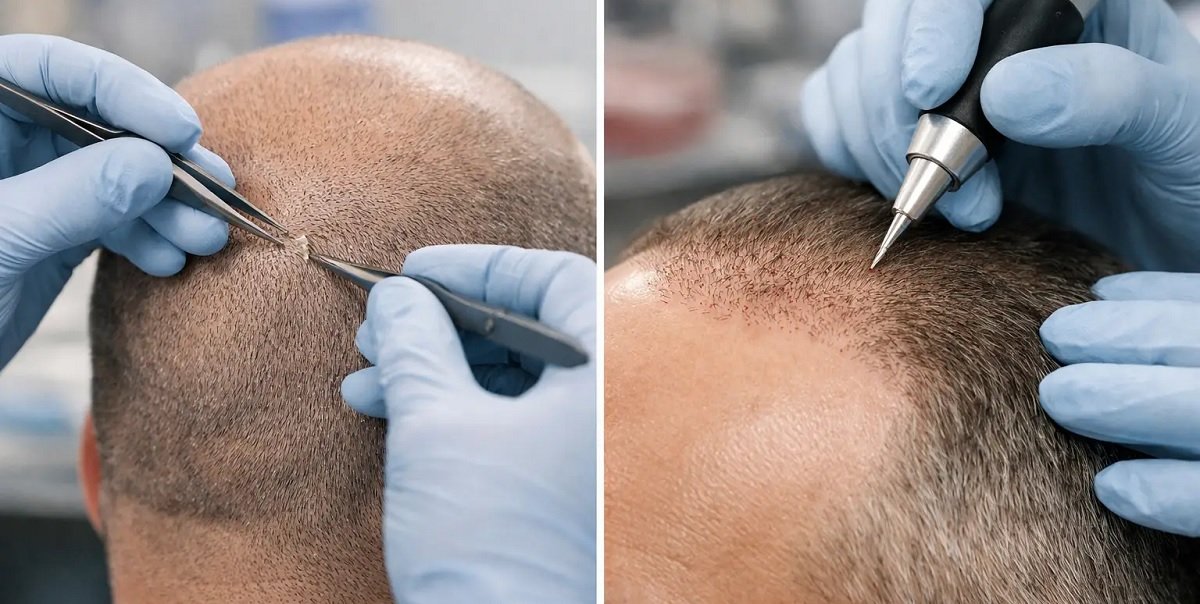
When looking into hair transplant options, FUE and DHI are two of the most commonly discussed techniques. Both use individual hair follicles from the donor area, but they differ in how those follicles are implanted.
So, FUE vs DHI: which is better for you? The answer becomes clearer when you look at the size of the treatment area, the type of hair loss, the desired density, and how the grafts need to be placed.
What Is FUE Hair Transplant?
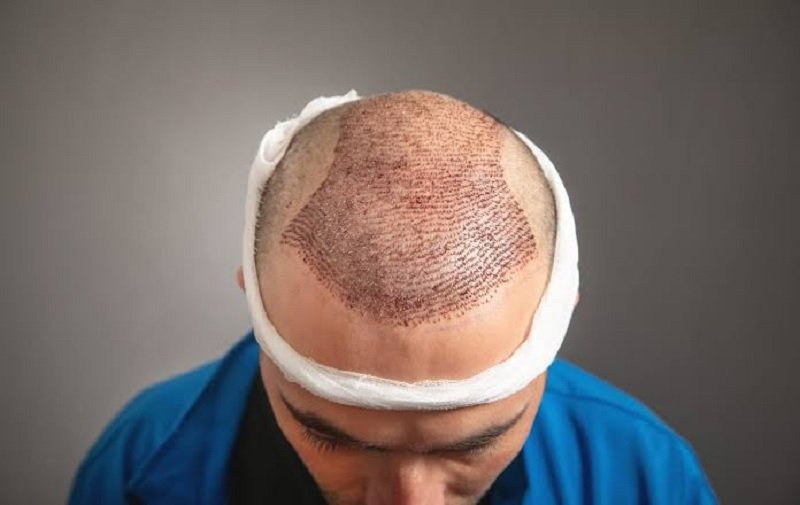
FUE, or Follicular Unit Extraction, involves removing individual follicular units from the donor area and transplanting them to areas affected by hair loss.
After the follicles are extracted, recipient sites are created in the treatment area. The grafts are then placed into these sites according to the planned hairline, angle, direction, and density.
FUE can be a suitable option when you need to restore:
- A receding or uneven hairline
- Frontal hair loss
- Crown thinning
- Larger areas of baldness
- Hair density across multiple areas
If you want to learn more about the procedure, see our guide to FUE Hair Transplant in Dubai.
Not sure where to start?
Our specialists will assess your scalp biology, graft capacity, and aesthetic goals to create a hair restoration protocol designed entirely for you — from your first consultation onward.
What Is DHI Hair Transplant?
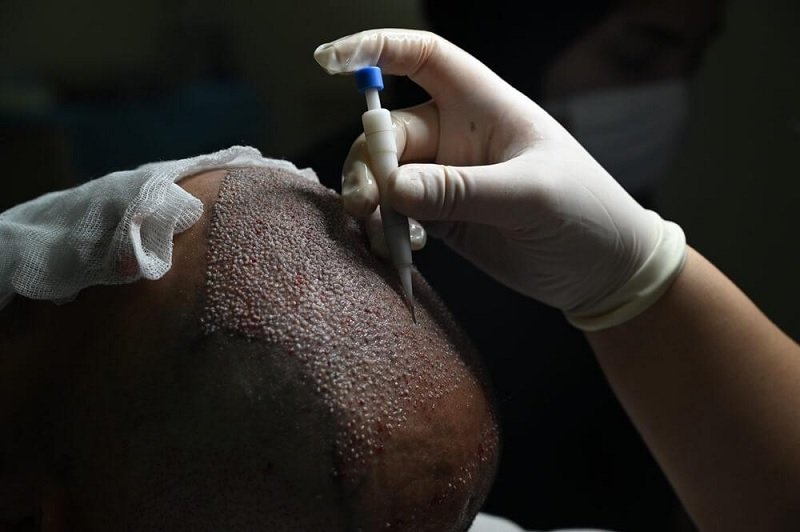
DHI, or Direct Hair Implantation, also uses individually extracted follicular units. The main difference is the implantation stage.
Instead of creating the recipient sites separately and then inserting the grafts, a specialized implantation tool is used to place the follicles directly into the treatment area.
DHI can be particularly useful when the goal is to:
- Add density between existing hairs
- Restore a small or localized area
- Refine a hairline
- Place individual grafts with precise control
- Work around existing hair
FUE vs DHI: What Is the Difference?
The main difference is how the extracted grafts are implanted.
| FUE | DHI | |
|---|---|---|
| Follicle extraction | Individual grafts | Individual grafts |
| Implantation | Grafts are placed into prepared recipient sites | Grafts are implanted directly with an implantation tool |
| Larger treatment areas | Often suitable | May be less practical for extensive coverage |
| Hairline restoration | Suitable | Suitable |
| Adding density between existing hair | Suitable | Particularly useful |
| Localized restoration | Suitable | Particularly useful |
| Recipient site creation | Done before graft placement | Integrated into the implantation process |
The distinction is important because FUE is often more practical when a larger area needs coverage, while DHI can be especially useful when the goal is precise implantation around existing hair or in a smaller treatment area.
When Is FUE a Better Option?
FUE may be the more practical approach when you need to restore a significant area rather than simply add a small amount of density.
Choose FUE when you need:
- Larger-area coverage: FUE can be used when the frontal area, crown, or several areas require transplantation.
- A new or redesigned hairline: Recipient sites can be planned before graft placement to establish the desired hairline shape and direction.
- More extensive restoration: When a higher number of grafts are required, FUE can provide a practical approach for covering broader areas.
- Restoration of significant bald areas: It can be used when there is little or no existing hair in the recipient area.
- Flexible graft placement: Recipient sites can be designed to create the appropriate distribution, angle, and direction before implantation.
For someone with a receding hairline combined with crown thinning, for example, FUE may be a practical choice when both areas require substantial coverage.
When Is DHI a Better Option?
DHI can be particularly useful when you are not trying to cover a large bald area and instead want to place grafts precisely among existing hair.
Choose DHI when you need:
- Density improvement: DHI can be useful for filling areas where existing hair is still present but looks thin.
- Localized restoration: Smaller areas may benefit from the direct implantation approach.
- Hairline refinement: Individual grafts can be positioned carefully to refine an existing hairline.
- Placement between existing hairs: Direct implantation can be useful when working around existing follicles.
- Precise graft placement: The implantation tool allows the graft to be placed directly into the intended position.
For example, someone with an established hairline but noticeable thinning behind it may benefit from DHI when the main goal is to increase density rather than create a completely new hairline.
FUE vs DHI for Hairline Restoration
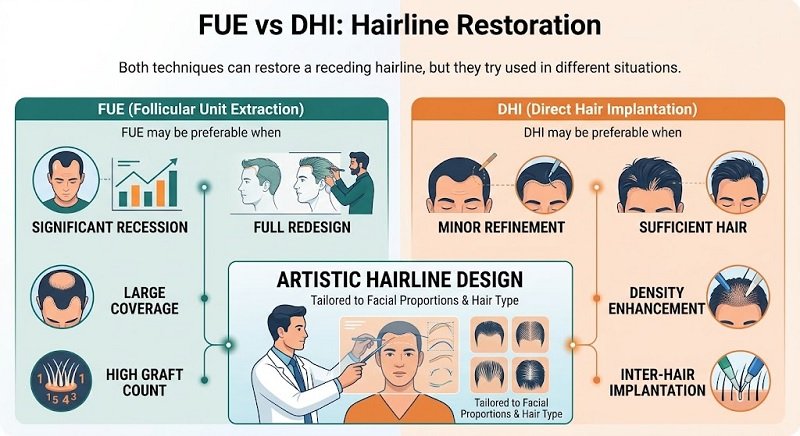
Both techniques can restore a receding hairline, but they may be used in different situations.
FUE may be preferable when:
- The hairline has receded significantly
- A new hairline needs to be designed
- A larger frontal area needs coverage
- A substantial number of grafts are required
DHI may be preferable when:
- The existing hairline needs minor refinement
- There is still considerable existing hair
- The main goal is adding density
- Grafts need to be placed between existing hairs
The design of the hairline remains important with either technique. It should follow the patient’s facial proportions and existing hair characteristics rather than using a standard shape.
FUE vs DHI for Crown Hair Loss
Crown restoration presents a different challenge because the hair grows in a distinctive spiral pattern.
FUE can be a good option when:
- The crown has a larger bald or thinning area
- A significant number of grafts are needed
- The treatment also includes the frontal or mid-scalp area
DHI may be useful when:
- The crown still has a reasonable amount of existing hair
- The main concern is reduced density
- Grafts need to be placed between existing hairs
The size of the thinning area is therefore an important consideration when comparing the two techniques.
FUE vs DHI for Adding Hair Density
If you still have plenty of hair but it has become noticeably thinner, the objective is different from treating a completely bald area.
DHI can be particularly useful for density-focused restoration because grafts can be implanted directly among existing hairs.
FUE can also increase density, particularly when the thinning area is larger or when restoration involves several parts of the scalp.
A simple way to think about it is:
- Large area with significant hair loss → FUE may be more practical
- Smaller area with existing hair → DHI may be particularly useful
- Hairline needs major reconstruction → FUE may be preferred
- Existing hairline needs refinement → DHI may be useful
- Several areas need restoration → FUE may offer greater flexibility
- Density between existing hairs is the main goal → DHI may be a suitable approach
FUE vs DHI: Recovery and Healing
Both procedures involve follicular extraction, so the donor area requires time to heal after treatment.
Temporary effects may include:
- Redness
- Mild swelling
- Sensitivity
- Small scabs
- Temporary shedding
The recovery period is influenced by the number of grafts, treatment area, and individual healing response. Following the clinic’s aftercare instructions is important during the early recovery period.
Which Gives More Natural-Looking Results: FUE or DHI?
Both FUE and DHI can produce natural-looking hair restoration.
The appearance of the result is strongly influenced by:
- Hairline design
- Graft placement
- Hair growth direction
- Graft quality
- Donor hair characteristics
- Appropriate density
DHI is not automatically more natural than FUE, and FUE does not automatically produce denser results. The technique needs to match the restoration task.
For example, creating a natural new hairline requires careful control of graft direction and distribution. Increasing density between existing hairs requires careful placement around the patient’s current follicles.
Can FUE and DHI Be Used for Different Areas?
Yes. Different areas of the scalp can have different restoration requirements.
For example:
- Receding hairline: May require hairline design and broader coverage
- Frontal thinning: May require restoration across a larger area
- Crown thinning: Requires attention to the natural growth pattern
- Localized thinning: May benefit from targeted graft placement
- Diffuse thinning: Requires careful consideration of the existing hair and donor supply
This is why the same technique is not necessarily ideal for every area of the scalp.
How Long Does It Take to See Hair Transplant Results?
Hair growth after transplantation is gradual with both FUE and DHI.
Some transplanted hairs may shed during the early stages. This does not necessarily mean the follicles have been lost. New growth develops over the following months, with the final appearance taking longer to mature.
The exact timeline varies from one person to another.
How to Choose Between FUE and DHI
Use your main restoration goal as a starting point:
If you have significant hair loss and need to cover a larger area:
FUE may be the more practical option.
If you have existing hair and mainly want to increase density:
DHI may be particularly suitable.
If your hairline has receded significantly and needs to be redesigned:
FUE can provide a practical approach for planning the new recipient area.
If your hairline is mostly intact but needs refinement:
DHI can be useful for precise placement of additional grafts.
If you need restoration across several areas:
FUE may offer more flexibility for broader treatment.
If you need grafts placed between existing hairs in a localized area:
DHI may be a suitable option.
A specialist can then assess your donor area, existing hair, and the extent of hair loss to confirm which approach fits your treatment plan.
FUE vs DHI: Frequently Asked Questions
Is FUE better than DHI?
FUE can be a better fit for larger areas of hair loss, significant hairline recession, or treatment requiring a larger number of grafts. DHI can be a better fit for localized thinning, density improvement, and placing grafts between existing hairs.
Is DHI more effective than FUE?
DHI is not inherently more effective. It has a different implantation approach that can be useful for specific restoration goals, particularly when precise placement around existing hair is needed.
Which is better for a receding hairline, FUE or DHI?
For significant hairline recession that requires a new hairline and broader frontal coverage, FUE may be more practical. DHI can be useful when the existing hairline needs refinement or additional density.
Which is better for crown hair loss?
FUE may be more practical when the crown has a larger bald area. DHI can be useful when the crown still has existing hair and the main goal is to improve density.
Can DHI be used for large bald areas?
DHI can be used for hair restoration, but it may be less practical when a large area requires a high number of grafts. FUE is often considered for broader coverage.
Does DHI have a faster recovery than FUE?
Both techniques involve follicular extraction and require a healing period. Recovery varies according to the procedure and individual rather than being determined solely by the technique’s name.
Does FUE or DHI leave scars?
Both involve individual follicular extraction and can leave small marks at the extraction sites. These differ from the linear scar associated with FUT.
Not sure where to start?
Our specialists will assess your scalp biology, graft capacity, and aesthetic goals to create a hair restoration protocol designed entirely for you — from your first consultation onward.
FUE or DHI: Which One Is Right for Your Hair Loss?
FUE and DHI are both established approaches to hair restoration, but they are suited to different treatment situations.
FUE is generally worth considering when you need broader coverage, a new hairline, or restoration across multiple areas. DHI is particularly useful when you want targeted density improvement, localized restoration, or precise placement between existing hairs.
A consultation allows the treatment team to assess your donor supply, existing hair, and areas requiring restoration before recommending the appropriate technique.
Related Articles
Continue exploring clinical insights from the Helia Medical Journal.
 Hair Restoration & Hair Transplant
Do Hair Transplants Last Forever? Which Method Lasts Longest?
Table of ContentsDo Hair Transplants Last Forever?Which Hair Transplant Method Lasts the Longest?FUE Hair TransplantFUT Hair TransplantDoes FUE Hair Transplant Last Forever?Do Hair Plugs Last Forever?What Can Affect…
 Hair Restoration & Hair Transplant
Hair Transplant Expectations: What’s Real and What’s Not?
Table of ContentsWhat Can You Realistically Expect From a Hair Transplant?Hair Transplant Expectations: Myth vs. RealityMyth 1: A Hair Transplant Guarantees a Full Head of HairMyth 2: Results…
 Hair Restoration & Hair Transplant
Wearing Hat After Hair Transplant: When Is It Safe?
Table of ContentsCan You Wear a Hat After Hair Transplant?Timeline for Wearing HatsWhat Type of Hat Is Best After a Hair Transplant?Can Wearing a Hat Dislodge Hair Transplant…
Comments
Share your questions or clinical experience with our readers.